


In 2022, a founder friend and I agreed we needed to get out of our inboxes and into something that required us to be both beginners and to use our hands, so we signed up for a six-week ceramics class.
During one session, she mentioned that maybe she needed to get on TikTok. At the time, this was not an obvious declaration for someone building a haircare brand. She wasn’t a celebrity founder, nor was she trying to become a creator, but she sensed that showing up as herself might matter.
That friend was Dianna Cohen, the founder of Crown Affair. In the years since, her personal channels have become a meaningful pillar of the brand’s larger world. At least six million people have watched her “twist and clip” air-dry method on TikTok and another 20,000 read her Substack, Take Your Time, where she writes about the rituals and references shaping her taste. In May, she launched a podcast, under the same name, interviewing the creative people in her orbit.
What Dianna has built extends well beyond haircare, yet still feels connected to Crown Affair, because her personal recommendations and musings carry the same sensibility as the brand she built. In part, that is because brands themselves have become more expansive. You no longer go to the pharmacy to buy whatever shampoo is on sale. You follow the brand on Instagram, wait in line for its pop-up, watch the founder see her product on a Sephora shelf for the first time, save the tutorial, and forward the newsletter.
Some of this shift has been shaped by the rise of building in public. Across TikTok and Instagram, founders have learned to narrate the process of making a brand: filming early samples, documenting formulation problems, packing orders, pulling back the curtain on fundraising, walking into retailers, or reacting to sellouts. By the time the product arrives, the audience is already invested in the brand and its context, far more than any About page or press quote could elicit.
For founders who sustain attention beyond launch, the draw is not only access to the process, but access to the point of view behind it. Cohen describes Crown Affair as a brand that “never started as a product idea– it started as a perspective.” Take Your Time gives that perspective another form: “Crown Affair answers through products and rituals,” she says, while “Take Your Time answers through ideas, conversations, and community. Different expressions of the same worldview.”
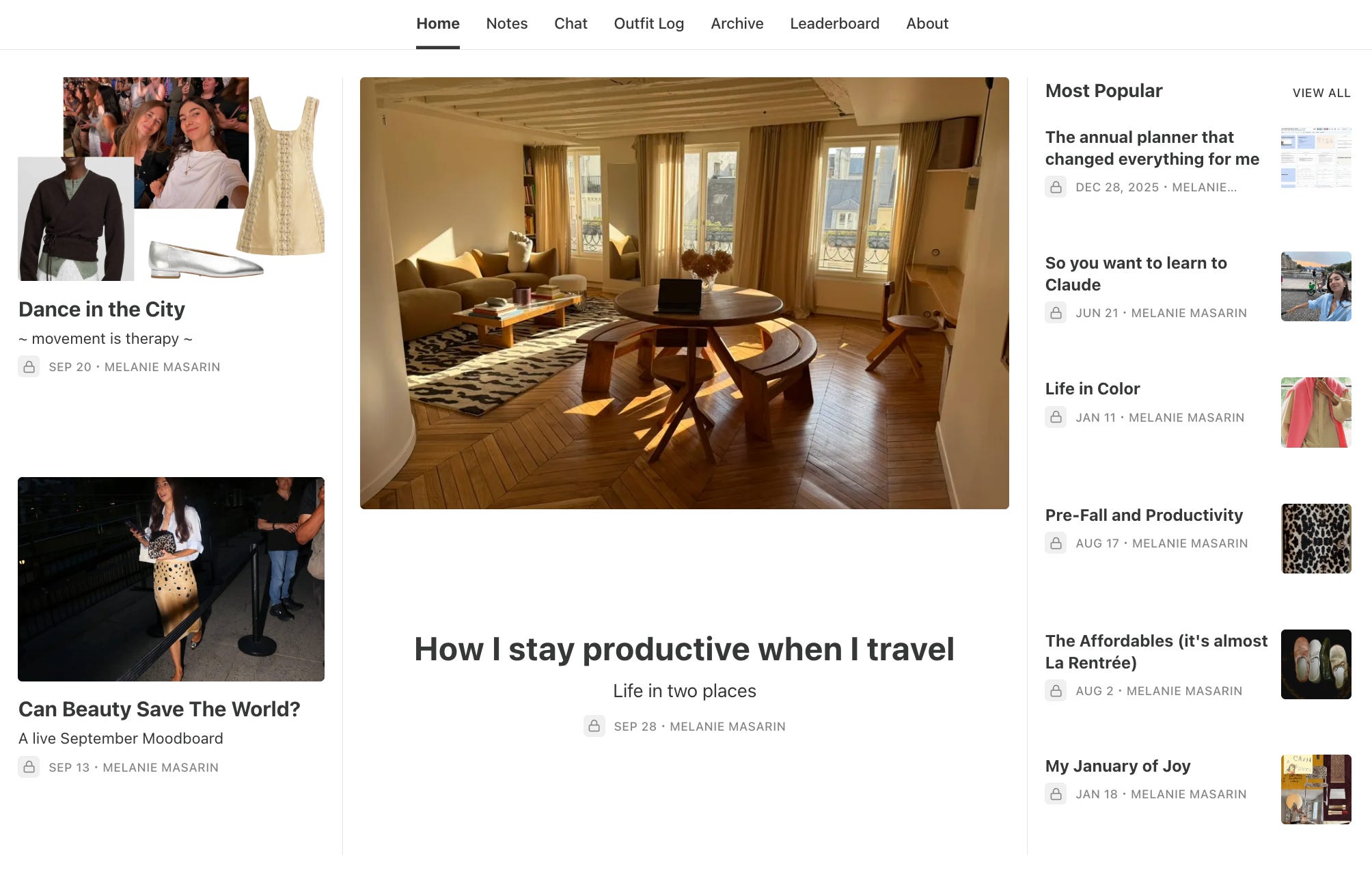
For Melanie Masarin, founder of Ghia, the overlap between personal world and brand world is natural, but carefully navigated. Ghia is built around many of the same references that fill Masarin’s own Substack, Night Shade, and her cookbook, Riviera: food, hosting, gathering, travel, and being truly present. “The source of inspiration is the same,” she tells me, “Where the two worlds overlap, I let them touch.”
But Ghia’s perspective is not built around Masarin alone. “Our customer is our hero, not our product,” she says. This distinction helps keep the brand world expansive.
Still, her own recommendations have become one way customers go deeper into that world. Masarin says a monthly Ghia newsletter inspired by Night Shade, filled with things she loved that month, is “by far the most clicked email” the brand sends. “It doesn’t necessarily sell more Ghia than the others,” she says, “but the engagement is much higher.”
The value, then, is not always conversion, but rather another reason to stay connected to a brand between purchases– a way to understand what the company values, what it notices, what it considers beautiful, and what kind of life it imagines its products living inside.
Still, the rise of the founder following creates a new kind of pressure. If a founder’s taste can deepen trust, it can also make the brand feel overly dependent on one person. Masarin is clear that while her own world and Ghia’s world overlap, she does not want to become the brand’s center of gravity. “Ghia is way, way bigger than I am,” she says. “Brands built around a single person can cap their own growth, because ultimately you want people to feel the product is for them.”
Cohen thinks about the boundary similarly. “I’ve always viewed founder visibility as an entry point, not the destination,” she explains. “Crown Affair was built to stand on its own — the products, the design, the philosophy need to resonate whether someone knows who I am or not.”
That may be the real answer to whether every founder needs a following. The strongest founder-led brands are the ones where the founder’s perspective has been translated clearly enough that it can be carried by the product, the team, and the community.
As Cohen puts it, “Founder-led has never been about personality. It’s about stewardship.” Masarin is even more direct: “As a brand matures, I think the founder’s job is to make herself less necessary.”
The founder’s following may help people enter the world of the brand, but it cannot be the whole world. At its best, founder-led storytelling gives consumers context: why this product exists, what references shaped it, what values hold it together. At its worst, it turns the founder into another content channel, expected to perform intimacy on top of running the company.
Masarin is wary of that becoming the expectation. “I really hope not,” she says when asked whether the future of consumer brands is more founder-forward. “And I say that for the sake of female founders in particular. The expectation to be visible, to build in public, to become a content machine falls much harder on women.”
So does every founder need a following? Probably not. But every brand does need a point of view strong enough for people to understand why it exists. Sometimes the founder truly is the clearest path in. But the more important question is whether the world she helps build can eventually stand without her at the center.

This is such an amazing article, from your examples to the overall point. It’s something I think about a lot, starting a media brand with myself, the founder, being behind the scenes.
Really admire these founders, and I loved this perspective!!